
On the trail of two Devon men, both named Otho Gilbert at St John the Baptist Church, Marldon, Devon : Part 1 The Grandfather.
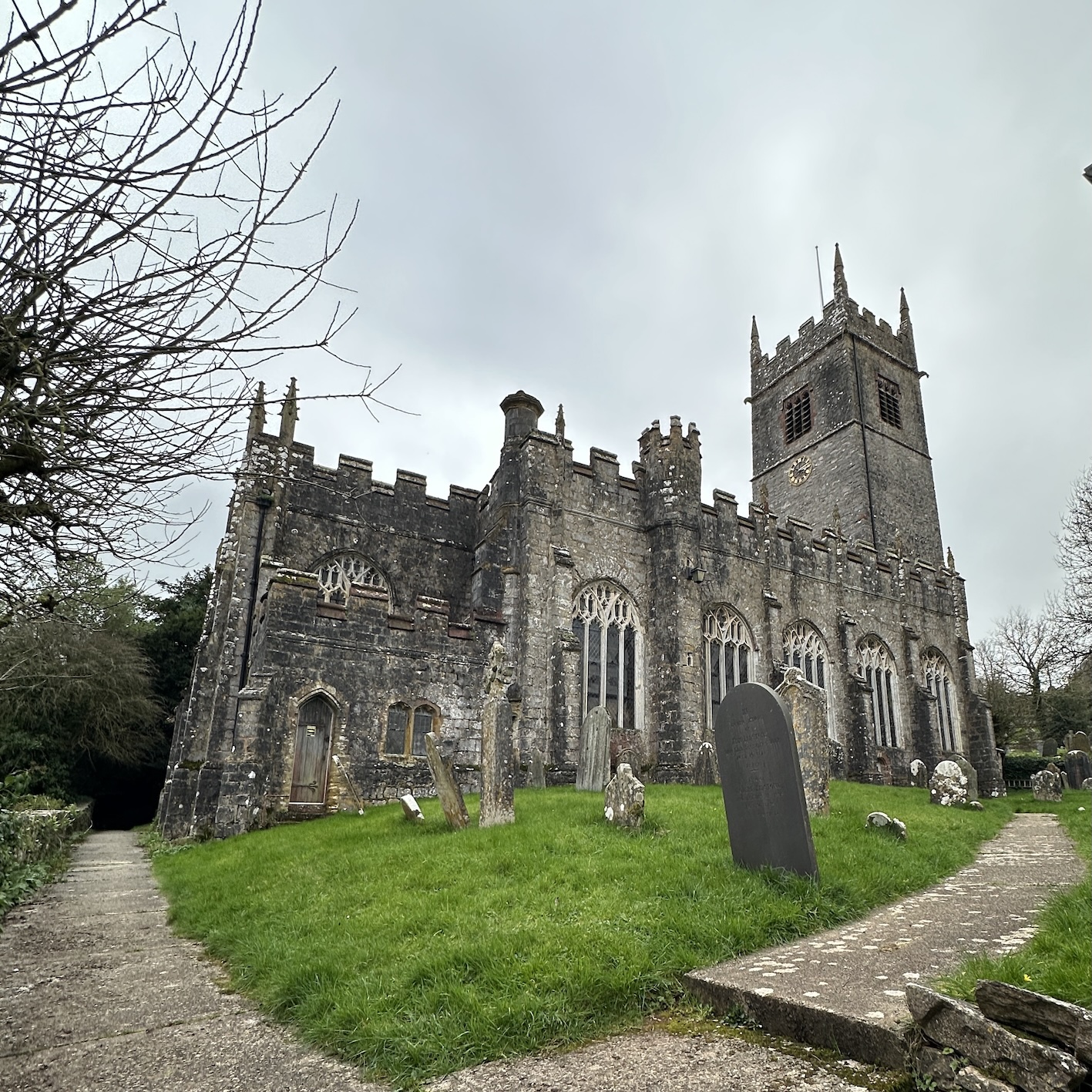
St.John The Baptist Church, Mardon, Devon
The Church of St John the Baptist stands on high ground next to the Church House Inn in the village of Marldon, Devon. This isn’t the first church to stand here. An entry in the register of Bishop Grandison of Exeter on 17 July 1348, describes a religious building on this site as ‘a chapel dependent on the Church of Paignton.’1
The impressive tower, with its polygonal stair turret, was added to the first building around the year 1400. In the mid-fifteenth century Otho Gilbert rebuilt the church.
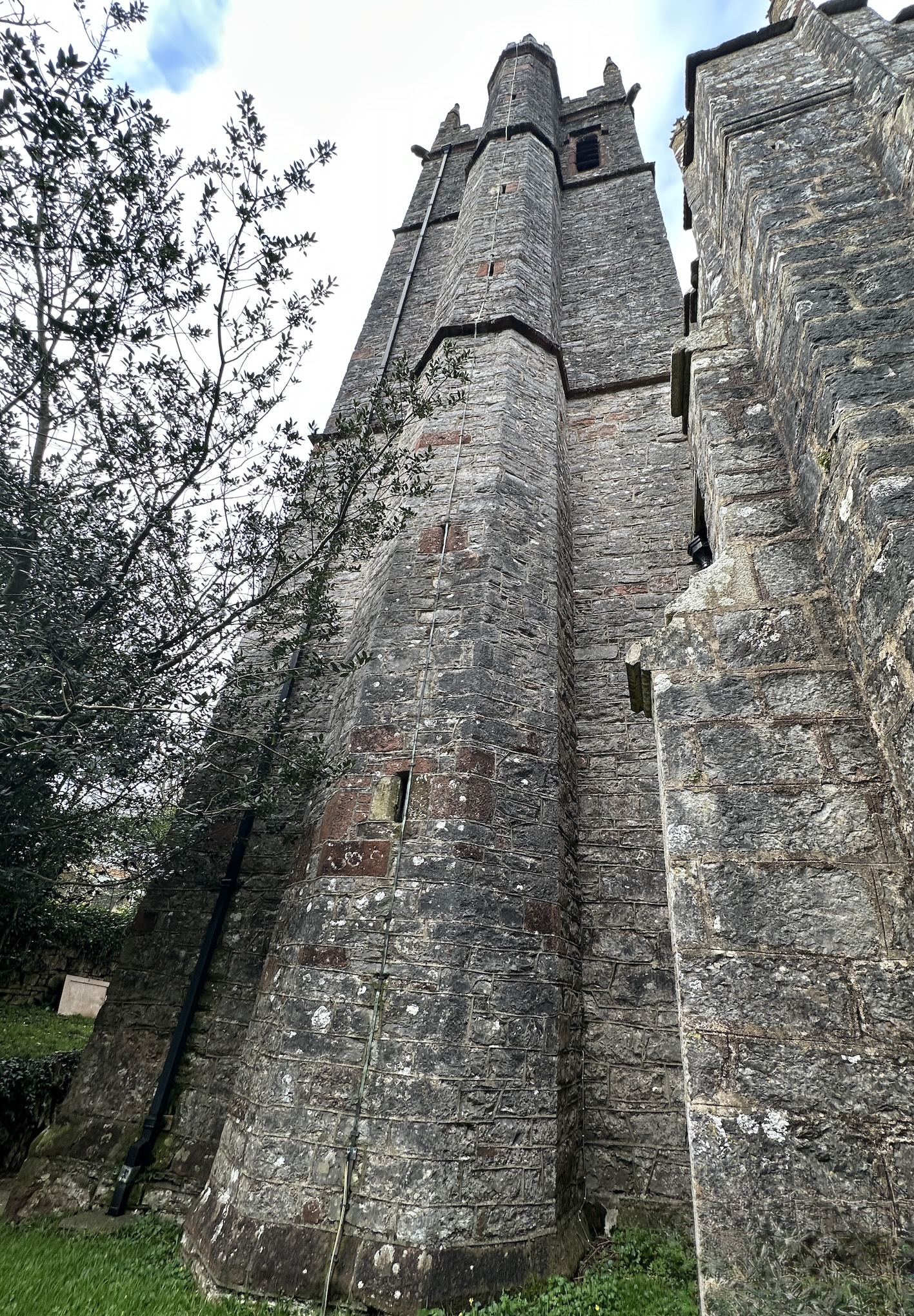
The Church Tower
In the vaulted porch, the arms of the Gilbert family loom out of the worn stone on one of the roof bosses. Inside, a regiment of bright red cross-stitch kneelers stands to attention on the pews; they are the diligent work of many hands.
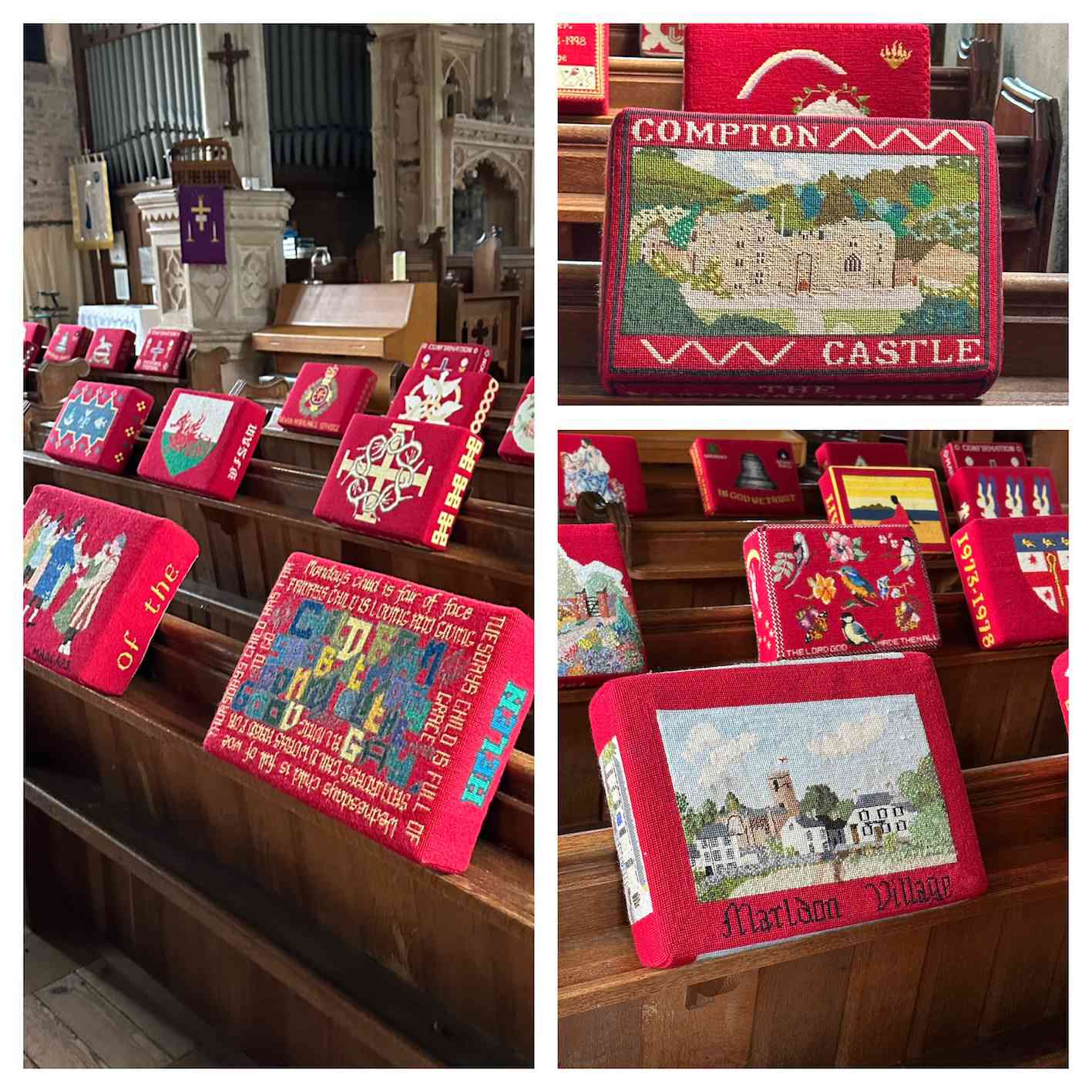
A cheerful array of cross-stich kneelers
I’m here in search of echoes of two men, a grandfather and grandson, each named Otho Gilbert. 2 Both have connections to this church. One rebuilt the church and is buried here. It is highly probable that the second, first husband of Katherine Champernowne, also found his last resting place among his ancestors in this church. A sermon preached at a month mind held for him in March 1547 caused quite a stir. 3 I will explore the controversy sparked at that event in Part II. In this post, I will concentrate on the first Otho.
Otho Gilbert (1418-1493)
Otho was born in 1417, his date of birth confirmed in a writ taken at Exeter on 14 April 1439. 4 This fascinating document records an enquiry regarding Otho’s inheritance as the eldest son of William Gilbert and Elizabeth Champernowne. (One of several marriages between the Champernownes and the Gilberts over the centuries.) Otho’s grandmother, Elizabeth, one of Richard Champernowne’s sisters, was an heiress. Some rather convoluted relationships led to Otho being named as one of the heirs to the estate of Elizabeth’s brother, ‘Otes’ Champernowne.
Those assembled in Exeter in April 1439 testified to young Otho’s age, swearing he was born at Compton and baptised in the church of St John the Baptist, Marldon on 24 March 1417. The writ provides a vivid snapshot of a day in medieval Devon, as each witness explains why they remember the date of Otho’s baptism.
It seems to have been a very eventful and, for some, a dangerous day. William Langham was robbed on his journey from Glastonbury; while out hunting, a deer ran Robert Lormer down and broke his left arm; William Norton fell into a moat at Newton Bushell and almost drowned. Witnesses also mention births, marriages, and deaths that fixed the date in their minds; William Prideaux’s daughter Katherine was born; Henry Marguyge married Alice Vernon, and John Symon’s son died after a long illness. Others describe the baptism ceremony itself: William Botour held the basin, Gervase Maryn held a candle, William Wonston a torch. John Furse recalls he saw Otho’s Walter Reynell, the godfather, give 40 shillings, while Elizabeth Carewe, the godmother, gave 30shillings and a gold ring.
It’s easy to imagine them standing in the church around the font, candlelight flickering on the walls, the priest holding baby Otho, the godparents looking on. However, it may not have been this particular fifteenth-century font, still used to baptise children here in the 21st century,
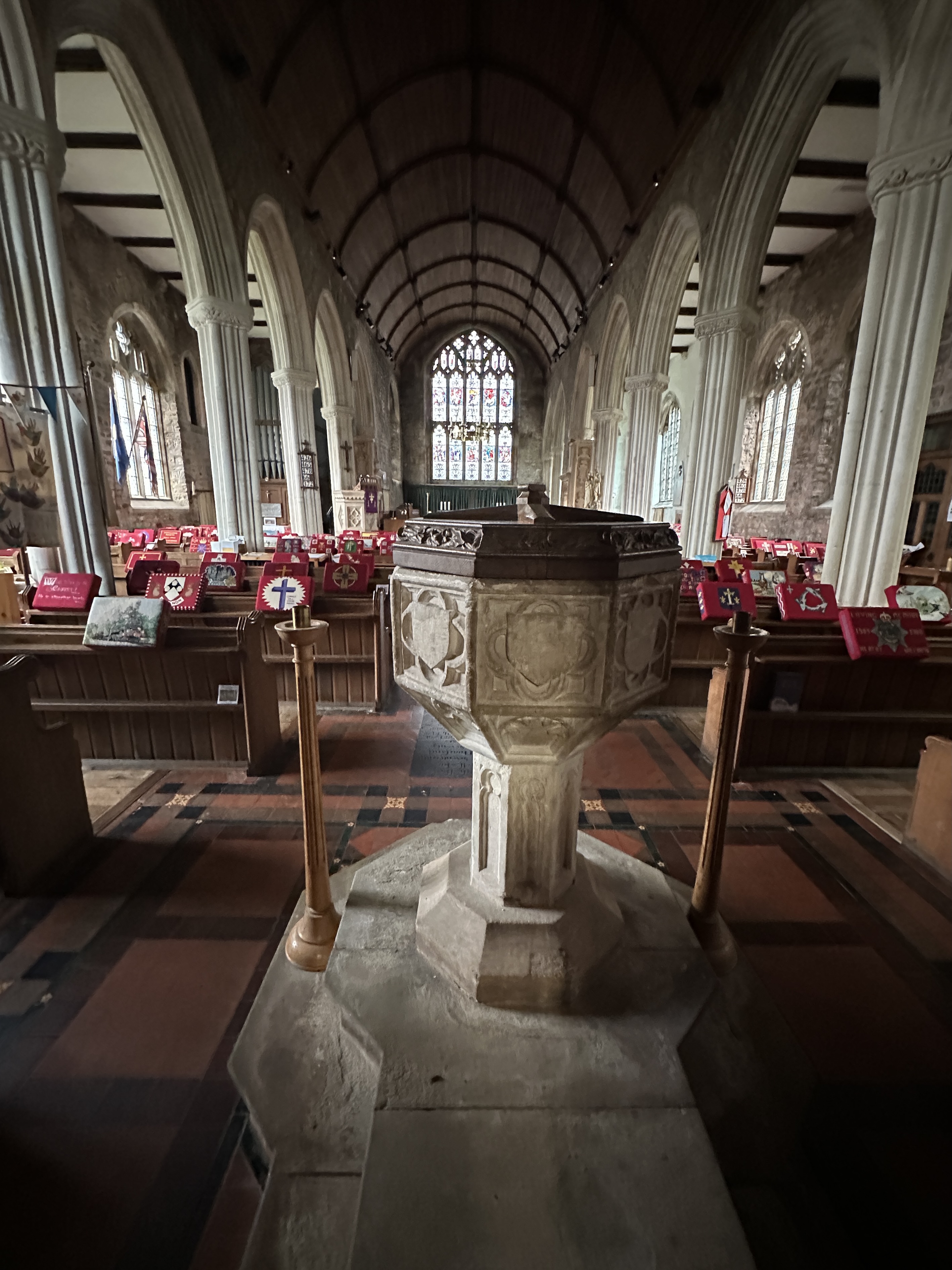
The fifteenth century font
Otho may have installed a new font, around 1460, as part of his later alterations to the church.
An Inquisition Post Mortem (IPM) of Agnes, widow of the Otes Champernowne mentioned above, says that after his father died Otho became a ward of the Abbot of Torre, from whom William Gilbert held property in Blackawton.5 Otho’s first wife was Alice Mulys.
Alice and Otho had a son named William who died in 1453. William had inherited lands from his grandfather, John Mulys, but during his minority the king held them. An IPM held in Exeter on 10 October 1443 says the lands remained in the king’s hands, so William was still a minor at the time of his death. 6
The church guidebook tells me that two flying angels bearing between them a shield of the arms of Gilbert, carved on the north arcade, may represent William borne heavenwards.7
Otho and Alice also had a daughter, Joan, born in 1437, who would marry John Norbury of Stoke D’Abernon, in Surrey. 8 The Norburys were a prominent family. John Norbury’s grandfather served as a soldier in the French wars and also held the post of Lord High Treasurer of England. This marriage alliance shows that the Gilberts’ connections extended well beyond the county of Devon.
After Alice died Otho married Elizabeth Hill. Daughter of Robert Hill of Shilston. With Elizabeth he had several sons, and a daughter, Isobel, destined to be the first wife of Thomas Grenville. One of Isobel’s daughters, Honor, is well known for the letters she wrote and received during her second marriage to Arthur Plantagenet, Lord Lisle.
Experts tentatively date the nave with north and south aisles, the porch, the chancel, and the priest’s vestry to around 1460.
Around the same time Otho also made changes at the Gilbert family home at Compton, enlarging the family quarters and making changes to the chapel.9
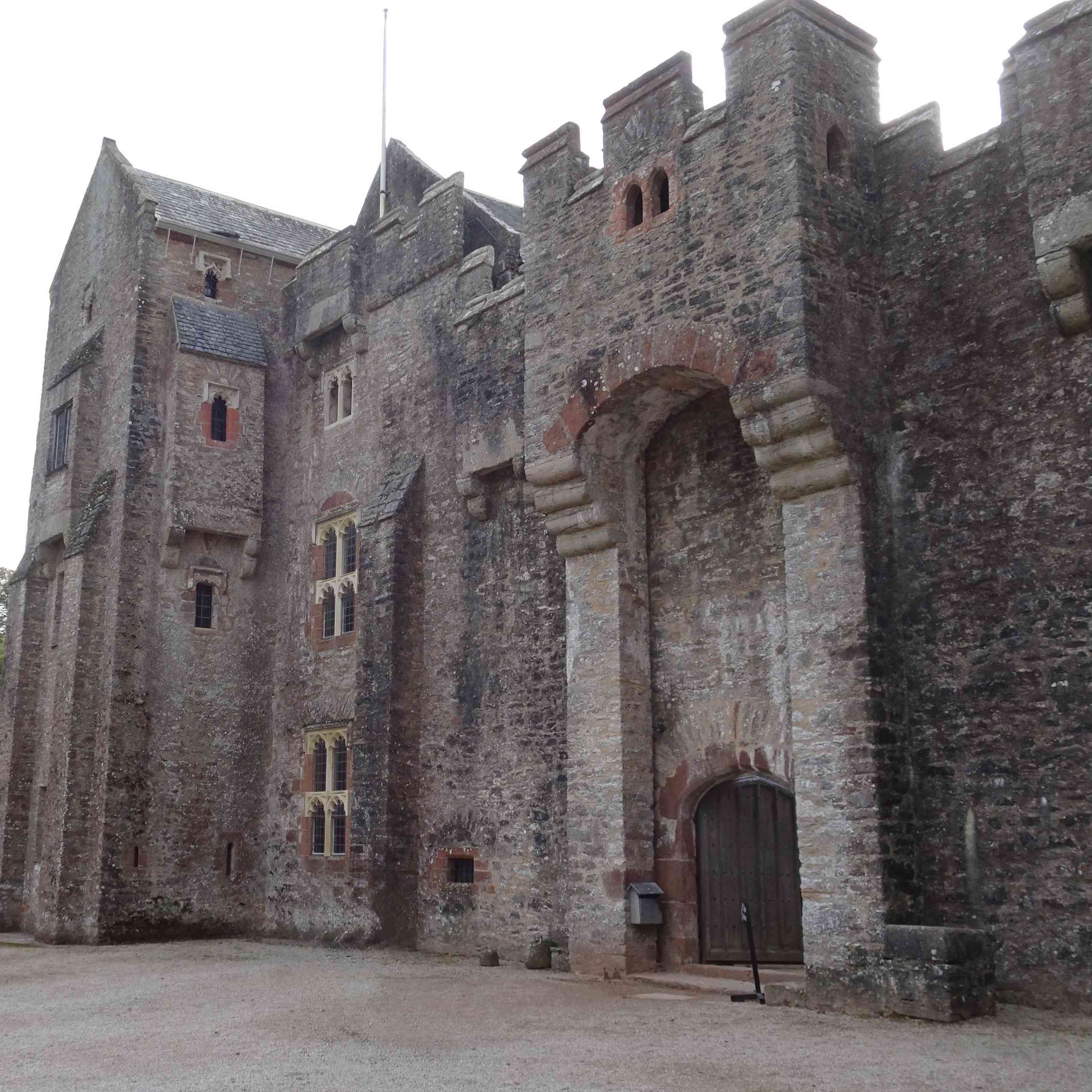
Compton Castle - a fortified manor house now in the care of the National Trust.
The historical record provides some clues about Otho’s life. With lands on the River Dart at Greenway, where there is deep anchorage, he had access to Dartmouth by river. He likely operated ships from there, as his father did when, in 1394, with his brother Richard and Oto Champernowne, William Gilbert had a licence to convey 100 pilgrims from Dartmouth to the shrine of Santiago de Compostella in a ship called “La Charite de Paynton.” 10
On 1 February 1460, King Henry VI commissioned Baldwin Fulford and Otho to arrest ships and vessels necessary for the conduct of an army. It’s interesting that Otho continued to provide ships after Edward IV took the throne. On 6 January 1462, King Edward commissioned Otho and others, including William Champernowne (great-grandfather of Katherine, who would later marry Otho ‘the grandson’), to take six ships for the king’s fleet against his enemies. 11
A small effigy clad in armour, thought to represent Otho, lies on one of two canopied altar tombs. They are not actual tombs. Otho is buried elsewhere in the church.
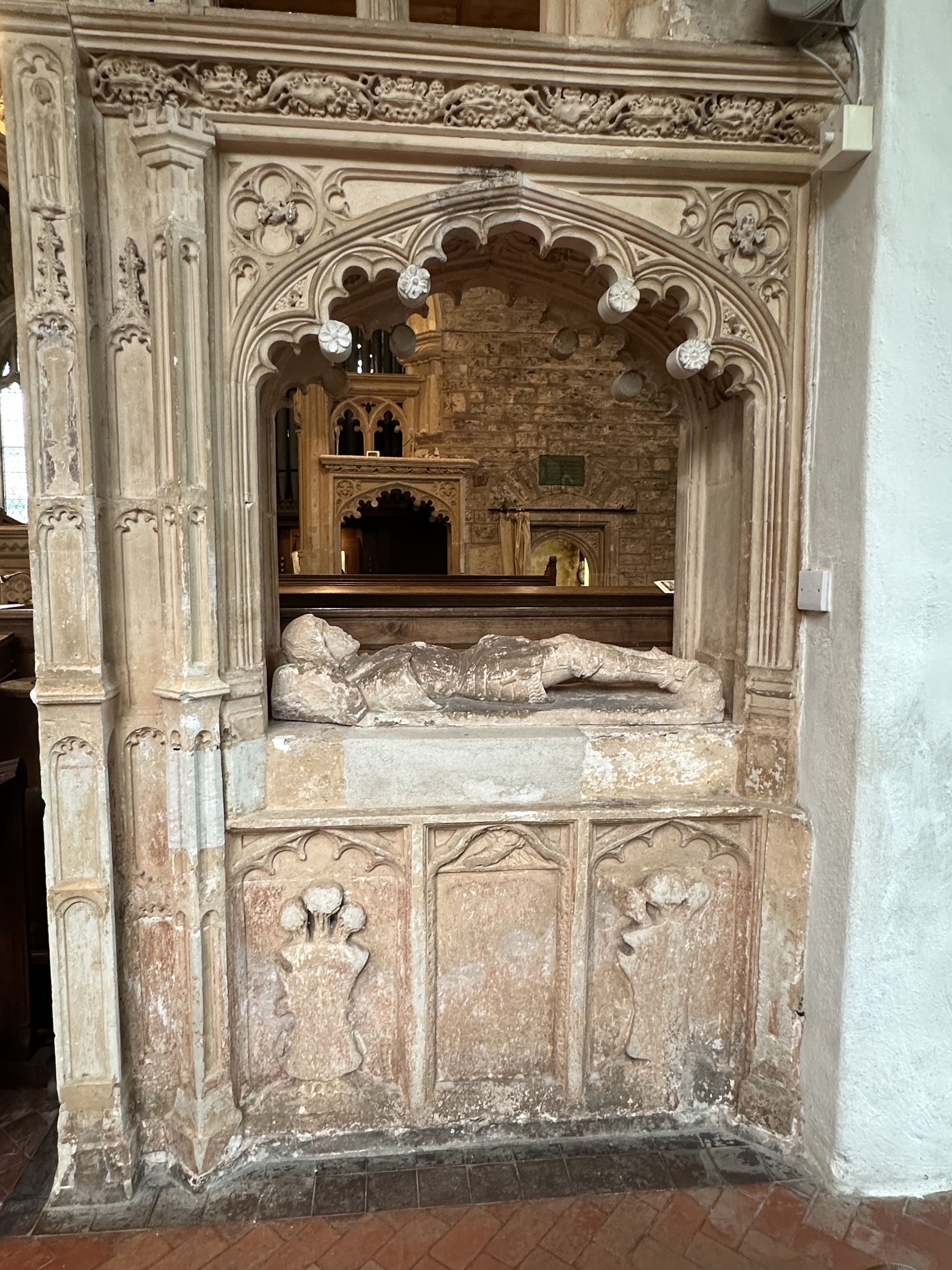
South cenotaph with effigy -- the one on the north side can be seen through the arch.
In June 1470, a ‘commission for array’ to the King’s brother, Richard Duke of Gloucester, lists Otho as the representative of Cornwall. 12 A commission for array empowered local men to muster, train, and array all able-bodied men in a county for national defence or for war. Perhaps Otho led his men to fight in battle.
In September of that same year, 1470, Richard Neville, Earl of Warwick, and the Duke of Clarence returned to England and instigated a rebellion to reinstate Henry VI. Edward narrowly escaped capture and fled to Bruges with his brother Richard of Gloucester and a few other men. Edward returned the following March and defeated Warwick on 14 April at the Battle of Barnet before achieving total victory at the Battle of Tewkesbury on 4 May 1471.
Otho’s activities during Edward’s absence remain unknown. However, after King Edward was once more secure on his throne, Otho seems to have prospered. He served on several royal commissions, as escheator for the county, and in 1475-76 as Sheriff of Devon. So we might conclude that Otho supported the House of York.
After the death of Edward IV. On June 5, 1483, ‘Otes’ Gilbert, described as “squier,” was one of 50 men ordered to prepare to receive the order of knighthood at the young king’s coronation at Westminster on June 2. 13 But the coronation of Edward V never happened; Richard, Duke of Gloucester, seized the throne, and Otho did not receive his knighthood. Otho does not appear in the record again until 1485, and we might imagine he kept his head down during the tumultuous reign of King Richard III.
Rumours that Henry Tudor was raising an army in France and might attempt to snatch the throne were circulating in the spring of 1485. It seems Otho was thinking about his immortal soul, perhaps fearing the outcome. Or he may have been concerned that another wave of plague had swept the country from 1479 to 1480. Whatever his motivation, on 9th May 1485 Otho received a licence to found a perpetual chantry of one chaplain to celebrate Divine Service in the parish church of St. John the Baptist, Marldon, at the altar of S. Mary. 14
A perpetual chantry was a medieval religious endowment funding a priest to sing daily masses for the soul of a founder, often at a specific, often enclosed, altar. At Marldon, prayers would be recited for the King and his mother Cecily, Duchess of York, along with Otho and Elizabeth his wife, and for their souls, and for the soul of his first wife, Alice. On this date, Richard III was king, and his wife Anne Neville had died on 16 March of that year. So, in the absence of a queen, prayers were for Cecily of York, the King’s mother. This might suggest Otho was still supporting Richard, although it could be nothing more than the standard form in use at that time. Otho’s chantry may also have established a school. A survey of chantries conducted in 1546 detailed a chantry at Marldon, ‘for the maintenance of two poor men at 8d. a week, and for the maintenance of a grammar school.’15
Otho died on 2 February 1493 (1494 in the modern calendar.). His somewhat damaged Inquisition Post-Mortem survives, listing all the properties he held at the time of his death, including land on the banks of the River Dart at Greenway. His will, proved 9 June 1494, names John ‘my son and heir’ and other sons: Thomas, Otys, William, Geoffrey. He asks that ‘his body be buried in the north part of the chapel of Marldon, under the foot of Our Lady, the chapel he had built.’16
As I stand in Marldon church, I wonder exactly where he lies — perhaps somewhere beyond the space the organ now occupies, near one of the two Beer stone ‘cenotaphs’ either side of the choir. They commemorate Otho and his wife, Elizabeth. A stone rood screen once linked them, and parclose screens likely enclosed a chantry chapel. Remnants of the screen are now in the room above the porch.
It is not clear if Otho had the cenotaphs built when he established his chanty chapel, or whether his son, John, who in the 1520s added another chapel on the south side, completed them as memorials to his parents. It may also have been John who set up the school.
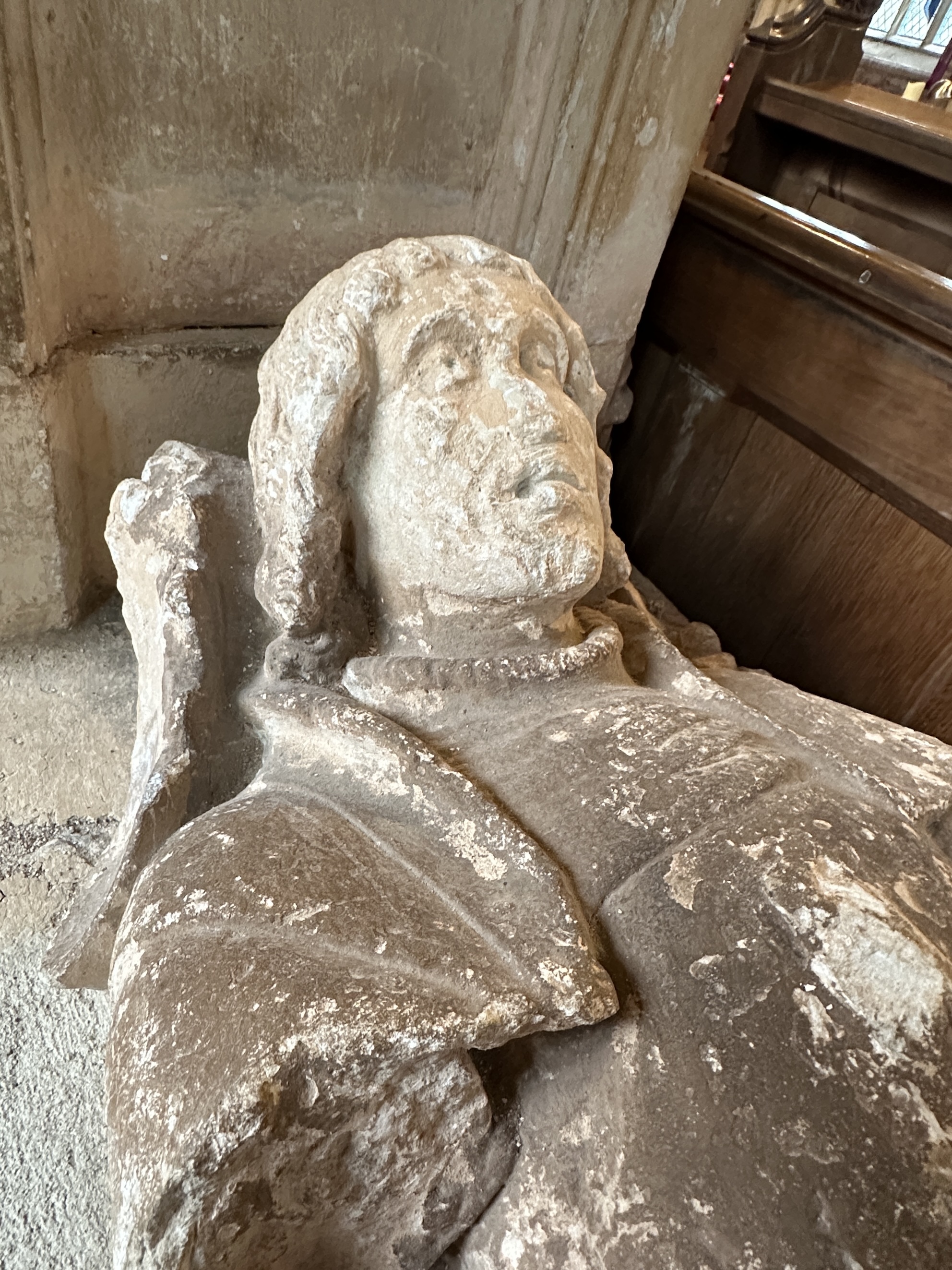
I return to the diminutive armour-clad effigy, moved in the 20th century and now lying on the south cenotaph.
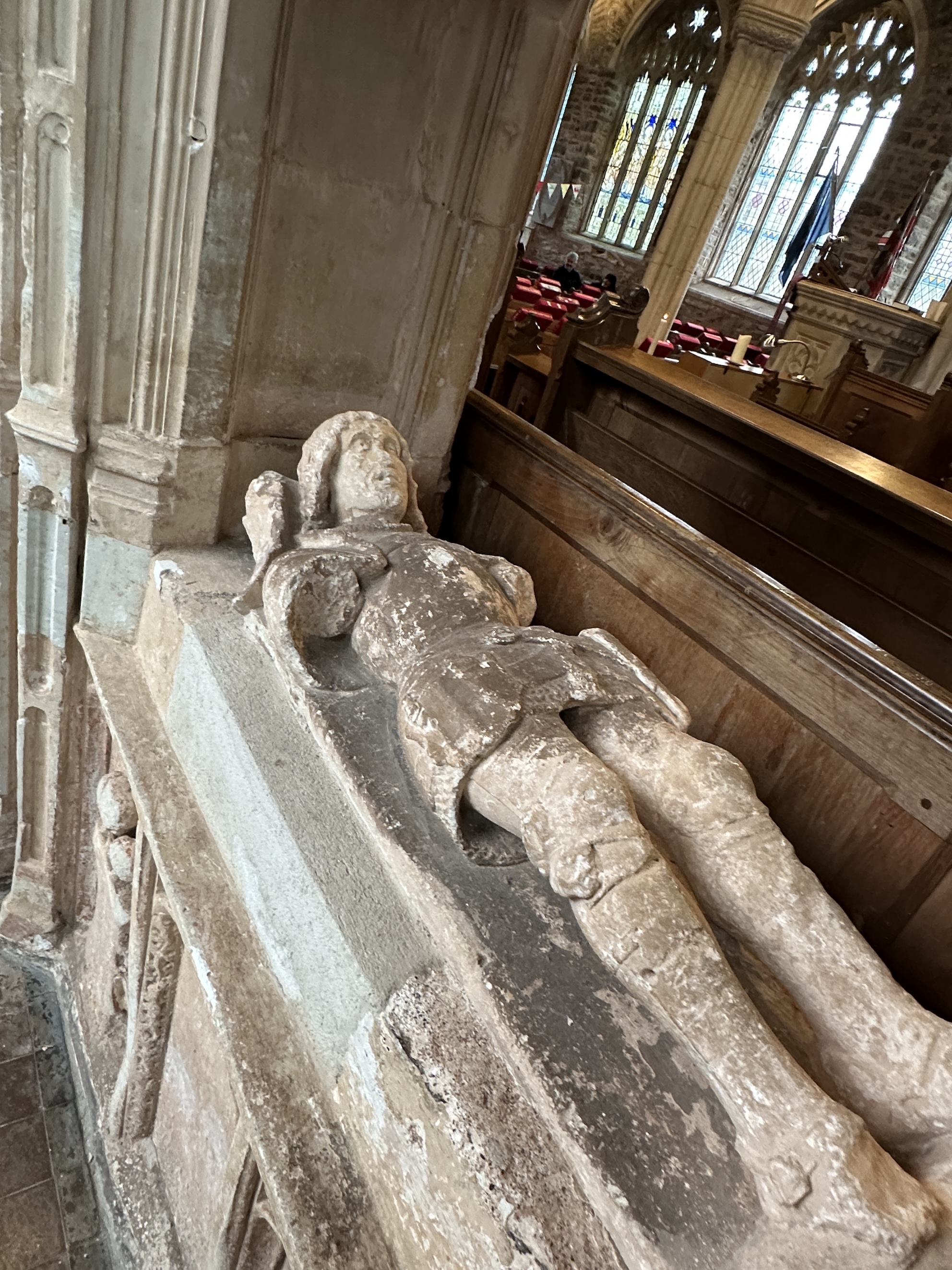
Effigy carved in Beer Stone, thought to represent Otho Gilbert (d.1493/94.)
Can this represent Otho? It is very short, leading to some suggestions that it may represent Otho’s eldest son, William, who died young. But small effigies of adults are not unknown. For instance, a small medieval female effigy in the parish church of St Andrew in Colyton, Devon, was for many years thought to represent a child, Margaret, daughter of William Courtenay and his wife Katherine of York. She was supposed to have died at the nearby Colcombe Castle after choking on a fishbone in 1512.
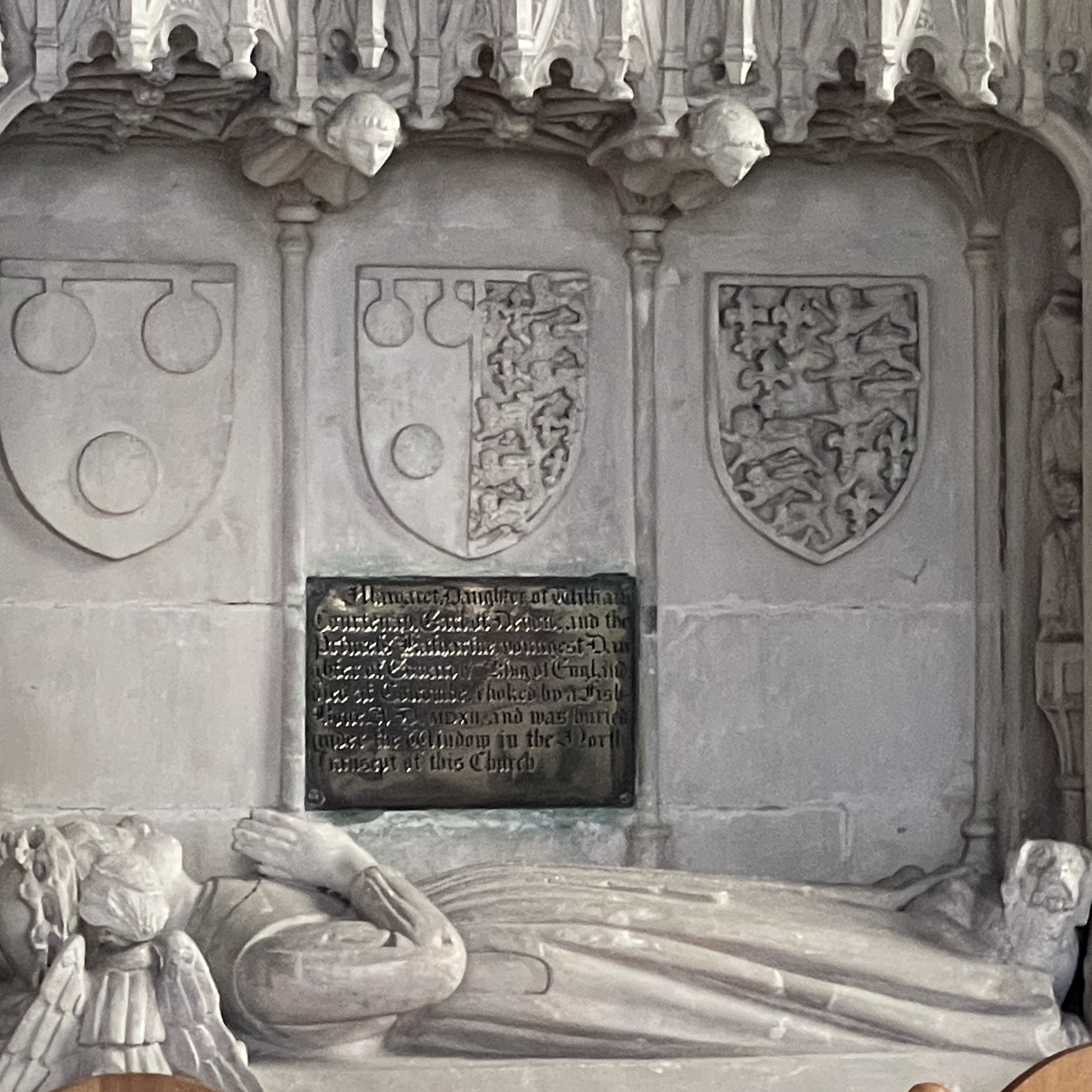
The Courtenay monument, St Andrew's Church Colyton Devon
But Margaret Courtenay lived to adulthood, married Henry Somerset, 2nd Earl of Worcester, and lived to at least 1520. It’s now considered more likely the monument honours an adult, Margaret Beaufort, wife of Thomas de Courtenay, 5th/13th Earl of Devon.
On the cenotaph on the north side at St. John the Baptist, Marldon, four small figures have survived in a series of niches, S. Anne, mother of the Virgin Mary, S. Anne teaching the Virgin Mary to read, S. Roch — the patron saint of plague victims — and S. Sebastian, while S, Lawrence and S. James are on the south cenotaph.
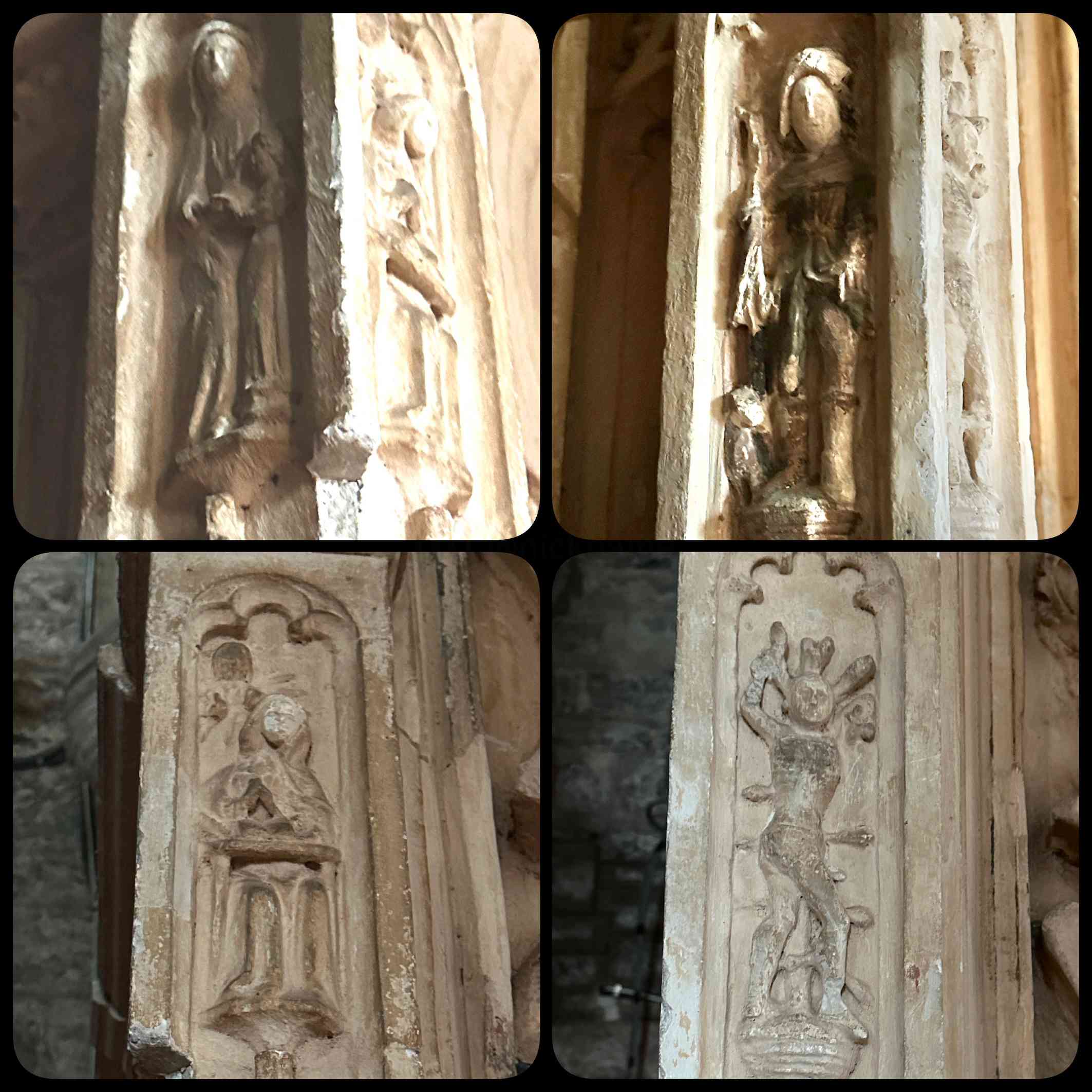
S. Anne, mother of the Virgin Mary, S. Anne teaching the Virgin Mary to read, S. Roch — the patron saint of plague victims — and S. Sebastian,
There is no doubt that Otho’s son John built the south chapel, known as the Compton chapel. When he made his will in 1538, John expressed the wish to be buried in the chapel he had built. John died childless, and his brother Thomas’s son, Otho inherited. I’ll return to him in Part II.
Here is Otho, the grandfather,
If you've enjoyed this post please share using the buttons below
Notes
- The register of John de Grandisson, bishop of Exeter, (A. D. 1327-1369), Hingston- Randolf, F.C., 18333, ed Winchester, p.1711
- Few given names were in circulation in the fifteenth and sixteenth centuries. Families used the same names repeatedly, sometimes even within the same generation. In the Gilbert family of Compton and Greenway, the name ‘Otho’ — to add to the confusion, sometimes written as Otes, Otys or Otto — became a favourite
- A month mind is a traditional Catholic service celebrating a memorial or Requiem Mass for a deceased person a month after their death or burial.
- The National Archives (TNA), C/39/153/ 68 (proof of Age, Otho Gilbert)
- TNA C139/49/41 (IPM Agnes Champernoun, widow of Otes Champernoun)
- TNA C139/153/22 (IPM William Gilbert died 1453)
- Marldon Church, Notes on its History and Architecture, church guidebook first written 1936, reissued 1951
- Some sources suggest Joan Gilbert first married Walter Raleigh of Fardel (died 1464) but this has yet to be verified
- Compton Castle, Guidebook, The National Trust, 2002
- Syllabus (in English) of the documents relating to England and other kingdoms contained in the collection known as Rhymer's Fedora, Rhymer, T, (1641-1713), ed. Hardy, T., London, p.526, ‘Licence to Oto Chambernoun and William and Richard Gilbert, to convey 100 pilgrims from Dartmouth to S. James, in a ship called "La Charite de Paynton”
- Compton Castle, Guidebook, The National Trust, 2002
- Calendar Patent Rolls Edward IV, Henry VI, 1467-77, Her Majesty’s Stationery Office,, London, 1900, p 220
- The Gilbert family held lands across the Tamar, in addition to their holdings in Devon and Somerset
- Syllabus (in English) of the documents relating to England and other kingdoms contained in the collection known as Rhymer's Fedora, Rhymer, T, (1641-1713), ed. Hardy, T., London, p714, Otes Gilbert, " squier," John Speke, Beaumont, and 47 others, are ordered to prepare to receive the order of knighthood at the K.'s coronation at Westminster on June 2
- Church guidebook, citing Patent Rolls 9 May 1485
- Leach, A.F., The Schools of Mediaeval England, Methuen, London, 1915, p.327
- TNA PROB 11/10/179, The will of Otys Gilbert